The Captain's Cure: What Master Mariners Understand About Motion, the Body, and the Sea That Medicine Has Yet to Fully Grasp
In the lexicon of luxury travel, seasickness is the subject nobody wishes to raise. It sits awkwardly beside conversations about Michelin-starred galley menus, hand-stitched teak interiors, and the particular shade of turquoise one encounters off the Florida Keys at golden hour. And yet, for the uninitiated guest preparing to step aboard a private charter for the first time, it is quietly the most pressing concern of all.
The popular assumption is that motion sickness is a matter of personal constitution — something you either suffer from or you don't, managed at best by a pharmacy-bought patch or a ginger chew purchased at the marina gift shop. What that assumption misses entirely is the profound degree to which an experienced captain can engineer the conditions of a voyage to render the question nearly moot.
At Prosline Charters, this is not incidental. It is craft.
The Sensory Conflict the Body Cannot Easily Forgive
To understand what a master captain actually manages, it helps to understand what seasickness fundamentally is. The condition arises from a neurological disagreement — a conflict between what the inner ear perceives in terms of movement and what the eyes communicate to the brain. When these two sensory systems deliver contradictory information, the brain interprets the mismatch as a potential sign of poisoning, triggering nausea as a defensive response. Evolution, in this instance, has not kept pace with the invention of the motor yacht.
What most landlocked physicians address is the symptom. What experienced captains address is the environment that produces the conflict in the first place.
The distinction is everything.
Reading Water the Way a Physician Reads a Chart
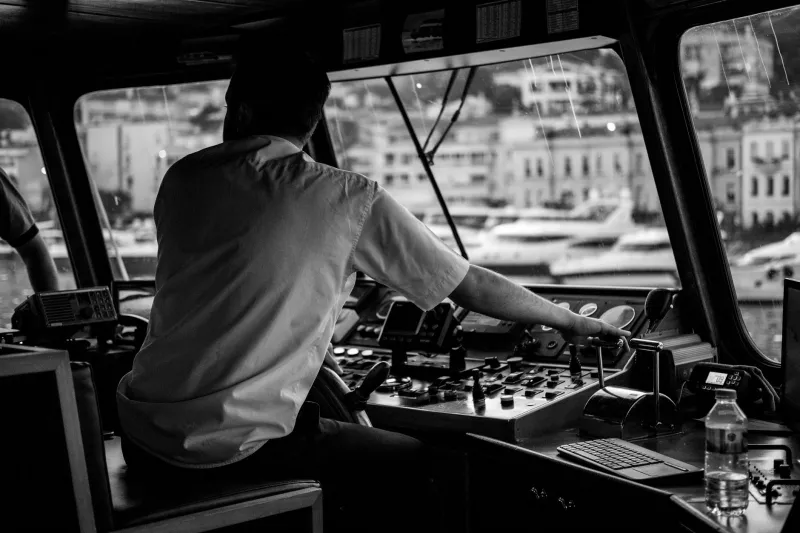
A captain with twenty or thirty years of offshore experience develops something that cannot be taught in a classroom: a granular, intuitive reading of how a given body of water will behave at a specific time of day, under a specific wind condition, against a particular hull design. This knowledge is not abstract. It is applied, in real time, to every navigational decision made on behalf of guests.
The choice of departure time, for instance, is rarely arbitrary aboard a well-run charter. Experienced captains are acutely aware that certain windows — particularly early morning hours before thermal winds develop — produce significantly calmer sea states along coastal corridors. A guest who boards at six in the morning and crosses from the Outer Banks to the Gulf Stream in glassy conditions will have a fundamentally different physiological experience than one who departs at noon into a building chop.
Similarly, the selection of a route is not merely a matter of distance or scenic preference. Seasoned captains understand that crossing a body of water at a specific angle relative to wave sets — neither directly into the swell nor broadside to it — can dramatically reduce the rolling and pitching motions that most aggressively trigger vestibular conflict. Slight adjustments in heading, imperceptible to the guest, can mean the difference between a pleasurable crossing and a miserable one.
Hull Dynamics and the Architecture of Comfort
Not all vessels move through water the same way, and the captains who know their specific hulls most intimately are best positioned to manage their guests' comfort. Deep-V hulls cut through chop with a sharper, more predictable motion than flat-bottomed designs. Catamaran configurations reduce rolling substantially compared to monohulls. Heavier displacement vessels absorb wave energy differently than lighter, faster craft.
Prosline's captains develop a proprietary familiarity with the particular motion signature of each vessel in their care. They understand how a given boat responds to a two-foot swell versus a four-foot swell, how its behavior changes when running with the current versus against it, and how speed adjustments alter the frequency of pitch and roll in ways that the body either tolerates or rejects.
Speed, in particular, is a lever that novice observers rarely consider. Slowing a vessel slightly can shift its encounter rate with wave sets — the rhythm at which the bow meets each successive swell — in ways that move the motion out of the frequency range most likely to disturb the inner ear. This is not guesswork. It is physics, applied with the intuition of long experience.
The Psychology of Anticipation and the Art of Distraction
Beyond the mechanical and navigational, there is a dimension of seasickness prevention that belongs entirely to the human realm — and here, the finest charter captains operate with the quiet sophistication of skilled psychologists.
Anticipatory anxiety is a well-documented amplifier of motion sickness. A guest who boards a vessel already convinced they will become ill is physiologically primed to do exactly that. Cortisol elevation, shallow breathing, and hypervigilant attention to bodily sensation all lower the threshold at which nausea manifests. A captain who senses this anxiety — through tone of voice, body language, or the careful questions a guest asks before departure — and addresses it with calm authority and specific reassurance can meaningfully alter the physiological outcome.
Engagement is equally powerful. Guests who are actively occupied — in conversation, watching the horizon, participating in the navigation, handling a fishing rod — are far less susceptible than those who retreat below deck and focus inward on how their stomach feels. The most experienced charter captains orchestrate the early hours of a voyage with this in mind, keeping guests topside, oriented toward the horizon, and mentally engaged with the world around them.
The horizon itself is not merely a metaphor. Fixing the gaze on a stable, distant reference point gives the visual system the information it needs to reconcile with the inner ear's input, interrupting the sensory conflict before it escalates. Captains who quietly position guests on the aft deck, facing forward, in the moments when conditions become momentarily livelier are doing something physiologically precise — even if it appears, to the untrained eye, merely hospitable.
Why Commercial Passengers Suffer More
The contrast between a private charter experience and a large commercial cruise is instructive here. Aboard a vessel carrying thousands of passengers, no captain can attend to the individual motion experience of any single traveler. Guests are routed into interior cabins far from the horizon, fed at fixed times regardless of sea state, and left largely to manage their own comfort with whatever remedies they brought aboard.
The private charter environment inverts every one of these disadvantages. A Prosline captain knows precisely how many guests are aboard, understands their individual histories and sensitivities from pre-departure conversations, can adjust itinerary and timing in real time, and is present — genuinely, attentively present — in a way that no commercial operation can replicate.
This is the luxury that matters most before the champagne is poured or the fishing lines are set: the assurance that the person at the helm has made your comfort their professional obsession, and possesses the knowledge, the experience, and the authority over the vessel to act on it.
The Quiet Confidence of a Well-Managed Crossing
Guests who charter with Prosline frequently remark, with some surprise, that they never felt the slightest discomfort — even on crossings they had privately dreaded. That outcome is rarely accidental. It is the product of a captain who read the weather window correctly, chose the departure time with precision, adjusted heading and speed with practiced subtlety, and kept the atmosphere aboard calm, engaged, and forward-facing in every sense.
Seasickness, at its root, is a problem of misalignment — between what the body expects and what the sea delivers. The finest captains spend their careers mastering the art of closing that gap. What they know, accumulated over thousands of offshore hours, is not found in any prescription pamphlet. It is earned, refined, and quietly deployed on behalf of every guest who trusts them with the voyage.