The Art of Being Read: Understanding the Unspoken Choreography of Luxury Charter Crew
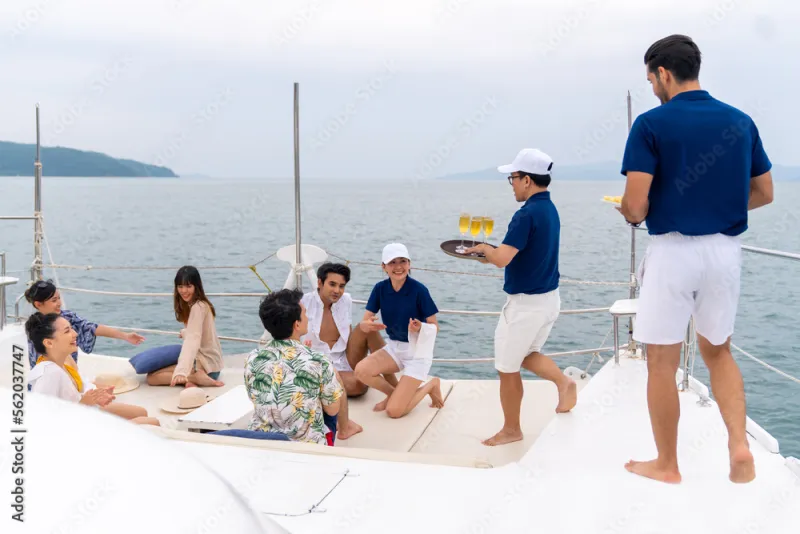
Photo: luxury yacht crew serving guests on deck ocean, via as2.ftcdn.net
There is a particular kind of magic that separates a genuinely extraordinary charter voyage from a merely comfortable one. It is not found in the thread count of the linens, the vintage of the wine cellar, or even the horsepower of the engines pushing you through open water. It lives, instead, in the space between a guest's thought and its fulfillment—a space that the most accomplished maritime crews have learned to collapse almost entirely.
For those new to the world of private charter travel, this phenomenon can feel disorienting in the most pleasant way imaginable. You glance toward the horizon and find a chilled glass materializing at your elbow. You shift in your deck chair and a crew member adjusts the shade canopy before the sun has even reached your eyes. You pause mid-sentence and the ambient music softens imperceptibly. None of it was requested. All of it was understood.
What you are witnessing is not coincidence. It is the result of rigorous professional training, refined situational awareness, and a silent, sophisticated language that flows continuously between crew members and their guests—one that most travelers never consciously register, but that defines the texture of every hour spent aboard.
The Architecture of Anticipatory Service
Professional maritime service at the luxury level operates on a principle that hospitality scholars sometimes call anticipatory intelligence—the capacity to identify a need before the person experiencing it has fully articulated it to themselves. This requires crew members to become acute observers of human behavior, reading posture, gaze direction, micro-expressions, and patterns of movement with the practiced fluency of a skilled interpreter.
Consider the stewardess who notices that a guest has glanced twice toward the galley stairs without rising. She does not wait. She appears. Or the deckhand who observes that a guest has begun unconsciously rubbing their arms as the afternoon breeze freshens and, without a word exchanged, retrieves a light wrap from below. These are not accidents of attentiveness. They are the product of a crew that has been trained to treat observation as a professional discipline.
For guests, understanding this dynamic fundamentally changes the quality of the experience. When you recognize that your crew is actively reading you, you become a more fluent participant in the exchange—not by issuing more commands, but by allowing yourself to be genuinely present rather than managing your own comfort.
What Crew Members Are Actually Watching
Experienced charter guests often describe a gradual awakening to the specific signals their crew monitors throughout a voyage. It is worth understanding several of the more common ones.
Gaze and attention direction is among the most reliable indicators a crew member can observe. When a guest's eyes linger on a particular area of the vessel—the bar, the swim platform, the horizon ahead—a skilled steward or deckhand notes it and considers whether action is warranted. It is a form of environmental reading that requires no words and leaves no awkwardness.
Postural shifts communicate restlessness, comfort, or a desire for transition. A guest who has been reclined and who suddenly sits upright and places both feet on the deck is signaling, consciously or not, that something has changed in their state of engagement. Attentive crew members respond by becoming slightly more present—checking in, offering a change of scenery, or simply making themselves visible.
Pace and rhythm across the course of a day tell a crew a great deal about a guest's preferred tempo. Some guests move through a charter with deliberate slowness, savoring each hour. Others accelerate through experiences, eager for the next activity. The crew that calibrates its energy and responsiveness to match a guest's natural rhythm creates a service experience that feels entirely effortless, because it never runs ahead of or behind the guest's own momentum.
Interpersonal dynamics among the guest party are perhaps the most nuanced signals a crew reads. A group that has grown quieter mid-afternoon may benefit from a suggested change of activity. A couple who have drifted to opposite ends of the deck may each appreciate a moment of private, unhurried service rather than collective attention. Experienced crew members read the social temperature of their guests with considerable sophistication.
The Crew's Own Silent Language
Equally fascinating—and largely invisible to guests—is the internal communication system that operates among crew members themselves. On a well-run luxury charter, crew rarely need to speak to coordinate. A brief exchange of eye contact between a chief stewardess and a deckhand can convey an entire sequence of instructions. A subtle nod signals that a guest has finished a course. A slight tilt of the head indicates that the couple on the aft deck would benefit from privacy.
This internal choreography is the result of extensive pre-voyage briefings, established protocols, and the kind of professional trust that develops among crew members who have worked together across multiple seasons. For guests, it manifests as an almost uncanny smoothness—a sense that the vessel is running itself, that comfort is simply the natural condition of being aboard.
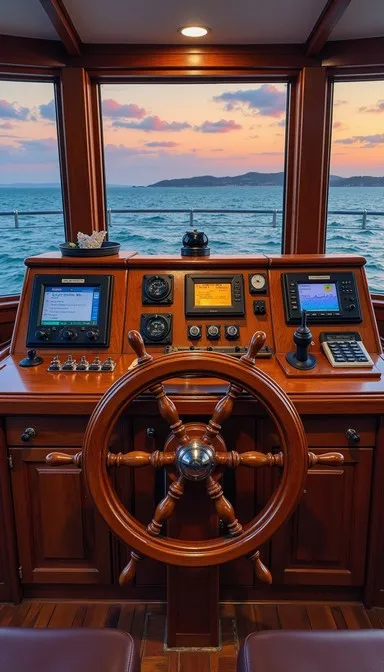
The captain, in particular, operates as the conductor of this ensemble. From the bridge, a skilled captain maintains awareness not only of navigation and weather but of the social and emotional atmosphere throughout the vessel. Decisions about speed, course, and timing are often made as much in response to guest energy as to maritime conditions.
How Guests Can Engage More Fluently
Understanding this dynamic is not merely an academic exercise. It offers practical guidance for guests who wish to extract the fullest possible value from their charter experience.
First, resist the impulse to over-manage your own comfort. Guests who are constantly rising to fetch items, adjusting their own environment, or apologizing for needs they haven't yet expressed inadvertently interrupt the service rhythm the crew has established. Trust that your crew is watching and that your needs will be met.
Second, allow yourself to be legible. There is nothing passive about this—it is, in fact, a form of sophisticated social grace. Guests who are genuinely present, who let their preferences show naturally rather than suppressing them out of politeness, make it possible for their crew to perform at the highest level.
Third, acknowledge the choreography when it moves you. A quiet word of appreciation—not effusive, simply sincere—communicates to your crew that their attentiveness has been noticed. It elevates the relationship from transactional to genuinely collegial, which, for many seasoned charter guests, becomes one of the most unexpected pleasures of the voyage.
A Language Worth Learning
The most memorable charter voyages are rarely defined by any single dramatic moment. They accumulate, instead, from hundreds of small exchanges—most of them wordless, many of them barely conscious—between guests who are fully present and crew members who have devoted their professional lives to the art of attentive service.
Learning to recognize this silent language does not require study or effort. It requires only a willingness to slow down, to notice, and to appreciate the extraordinary human skill that makes a luxury charter feel less like a service and more like a collaboration between people who understand, instinctively, what a remarkable day on the water ought to feel like.