One Aboard: Why America's Most Accomplished Individuals Are Chartering Private Yachts Alone
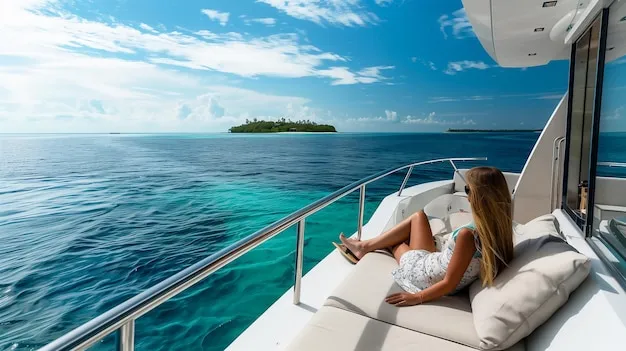
Photo: solo traveler on luxury yacht deck ocean solitude, via img.freepik.com
There is a particular irony embedded in the life of the highly successful American professional. The more one achieves, the more relentlessly one is claimed by others — by colleagues, by clients, by family obligations, by the ambient noise of a digital existence that recognizes no boundary between work and rest. Wealth, which promises freedom, frequently delivers its opposite: a schedule so thoroughly colonized by obligation that genuine solitude becomes the rarest commodity of all.
It is against this backdrop that a notable trend has taken shape in the luxury maritime market. Private yacht charters — long associated with groups, families, and corporate entertaining — are increasingly being booked by a single individual traveling alone. No entourage. No agenda. One guest, one vessel, and the open water.
The Arithmetic of Intentional Solitude
To understand the appeal, it helps to consider what a solo charter actually provides that almost nothing else can: unstructured time in a genuinely boundless environment, attended by professional crew whose sole purpose is to support the experience, with no competing interests aboard and no social performance required.
In a resort, solitude is approximate at best. Other guests occupy the common spaces. The lobby, the restaurant, the pool — all carry the ambient presence of other people and their expectations. On a private vessel at anchor in a quiet cove off the coast of Maine or tucked into a secluded Bahamian inlet, solitude is absolute. The horizon belongs entirely to you.
For individuals accustomed to operating in environments defined by constant evaluation — the boardroom, the courtroom, the trading floor — this completeness of privacy is not merely pleasant. It is restorative in a way that few other experiences can replicate.
"I haven't eaten a meal alone in probably four years," one New York-based private equity executive told us. "Every breakfast is a working breakfast. Every dinner is a relationship. When I'm on the water by myself, I eat when I'm hungry, I go where I want, and nobody needs anything from me. I come back a different person."
What Solo Chartering Reveals About Contemporary Wealth
The willingness to charter a private yacht for a solo voyage signals something meaningful about how affluence is being redefined in the current moment. For an earlier generation of wealthy Americans, conspicuous consumption was the dominant register — the large gathering, the visible display, the social proof embedded in the guest list.
The solo charter inverts this logic entirely. It is a choice that, by definition, cannot be witnessed or validated by others. It is luxury consumed in private, for private benefit, with no audience to impress. Analysts of high-net-worth behavior have begun to identify this pattern as characteristic of what some call the "post-display" wealthy — individuals for whom the accumulation of experiences and the recovery of autonomy have replaced the accumulation and display of objects as the primary expression of success.
In this sense, the solo charter is less about escape and more about reclamation — a deliberate act of repossessing one's own time and attention.
The Charter Company's Evolving Role
For providers in the luxury maritime sector, the rise of the solo traveler has prompted meaningful adaptations in how voyages are conceived and delivered. The solo guest does not want a scaled-down group experience. They want an experience designed from the outset around the preferences, rhythms, and interests of one individual.
At Prosline Charters, this means that the pre-voyage consultation process for a solo booking carries particular weight. Understanding whether a guest seeks active engagement — fishing expeditions, diving, shore excursions — or genuine stillness, or some calibrated alternation between the two, shapes every element of the voyage. The provisioning, the itinerary, the pace of each day, even the communication style of the crew: all are oriented toward a single set of preferences rather than negotiated across multiple guests.
Crew selection, too, becomes an especially considered matter. The ideal crew for a solo charter possesses a rare professional quality: the ability to be genuinely present and attentive while occupying as little of the guest's psychological space as possible. Hospitality without intrusion. Availability without imposition.
The Psychology of Being at Sea Alone
There is a body of research suggesting that time spent near open water produces measurable shifts in cognitive and emotional state — reductions in cortisol, improvements in sustained attention, a general quieting of the mental noise associated with high-pressure professional environments. For the solo traveler, these effects are amplified by the removal of social obligations that would otherwise continue to consume attentional resources even in a beautiful setting.
Put simply: when you are not managing anyone else's experience, you can fully inhabit your own.
Many solo charter guests report that the first day at sea is characterized by a kind of decompression — the gradual release of the hypervigilance that professional life demands. By the second or third day, something shifts. Thoughts clarify. Decisions that seemed impossibly complex on land resolve with unexpected ease. Several guests have described making significant personal or professional decisions — career pivots, philanthropic commitments, long-deferred creative pursuits — during or immediately following solo voyages.
The open water, it seems, has a way of returning one to oneself.
Designing the Solo Voyage
For those considering their first solo charter, a few considerations deserve particular attention. The choice of cruising ground matters enormously. The protected waters of the Chesapeake Bay offer gentle conditions and rich cultural history along the shoreline. The Florida Keys provide warm, crystalline water and exceptional fishing. The coast of New England offers dramatic scenery, vibrant harbor towns, and a pace that rewards unhurried exploration.
Duration is equally significant. A solo voyage of fewer than three days may not allow sufficient time for the decompression phase to complete before the return journey begins. Many experienced solo charter guests recommend a minimum of five to seven days — enough time to move through the initial adjustment and arrive at the deeper quality of presence that makes the experience genuinely transformative.
The solo charter is, at its core, an argument for the radical value of one's own company. In an era that commodifies connection and pathologizes stillness, there is something quietly revolutionary about a single person, a well-appointed vessel, and the open sea.
Prosline Charters invites you to consider what that horizon might offer you.