The Prescription Nobody Warned You About: How Luxury Charter Voyages Are Becoming the Wellness Strategy of Choice for America's Elite Professionals
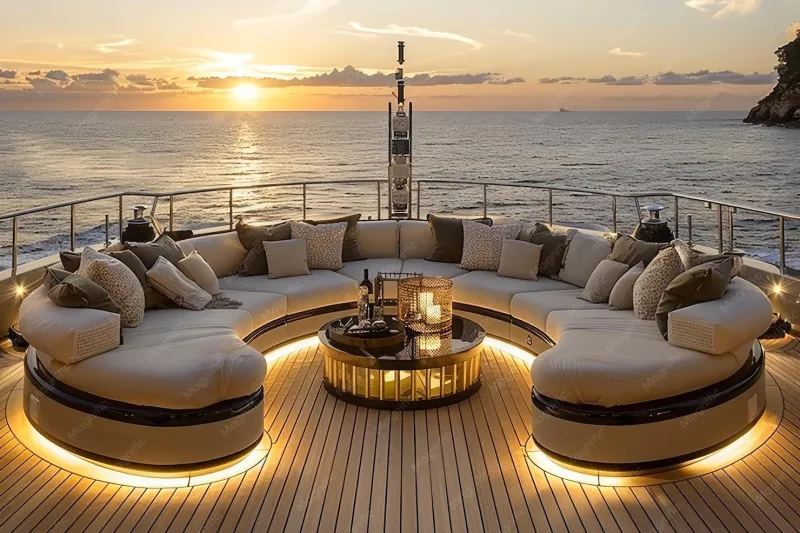
Photo: executive relaxing on luxury yacht deck open ocean, via img.freepik.com
For decades, the archetype of the American executive on vacation was a contradiction in terms. The laptop came along. The phone never left the hand. The resort suite became a satellite office with better thread counts. Somewhere between the first cocktail and the return flight, the boundary between recovery and performance collapsed entirely — and nobody seemed to notice until the consequences arrived.
That calculus is shifting. Quietly, and with considerable intentionality, a segment of America's most accomplished professionals has begun treating private charter voyages not as the reward at the end of a productive quarter, but as a foundational element of sustained high performance. The ocean, it turns out, is not merely a destination. For those willing to commit to it fully, it is a system reset.
The Digital Severance Problem
Behavioral psychologists have long understood that true cognitive recovery requires more than physical rest. It demands what researchers at the University of California, Irvine have described as "attentional restoration" — a sustained period during which the brain is no longer compelled to process the fragmented, interrupt-driven demands of digital communication. The problem with most conventional retreats, however luxurious, is that they fail to create genuine severance from those demands. A five-star spa in Scottsdale remains connected to the same grid. A mountain lodge in Aspen still has Wi-Fi.
The private charter yacht, by contrast, imposes a form of structural distance that is difficult to replicate on land. Once a vessel clears the harbor and the coastline recedes, the psychological contract between a professional and their obligations undergoes a fundamental renegotiation. The absence of connectivity is not experienced as deprivation — it is experienced, often for the first time in years, as permission.
"There is something about the physical separation from shore that the mind recognizes as categorically different from simply turning off notifications," notes the framework articulated by researchers studying what is now commonly termed "digital displacement therapy." The brain, accustomed to anticipating interruption, gradually releases that vigilance when it understands that interruption is structurally impossible.
What the Data Is Telling Executives
The evidence accumulating around maritime wellness experiences is difficult to dismiss. Studies measuring cortisol levels — the primary biochemical marker of chronic stress — in subjects who spent extended time aboard private vessels have consistently shown reductions that outpace those recorded in traditional spa or retreat environments. More compelling still is the research emerging around creative problem-solving capacity: executives returning from multi-day voyages demonstrate measurably improved performance on divergent thinking assessments compared to those returning from land-based luxury retreats of equivalent duration.
The hypothesis is straightforward. The ocean environment engages what psychologists call "soft fascination" — a mode of effortless, low-demand attention that allows the prefrontal cortex to recover its executive function without the effortful suppression required in busier environments. The rhythm of the water, the absence of artificial urgency, the constancy of the horizon — these are not incidental aesthetic pleasures. They are neurological inputs with measurable outputs.
For professionals whose competitive advantage depends on clarity of judgment and creative agility, this is no longer an abstraction. It is a business case.
The Annual Priority
Among the executives and entrepreneurs who have made chartered voyages a recurring fixture of their annual calendar, the language used to describe the practice is notably consistent. These are not vacations. They are, in the words of one Boston-based private equity principal who charters annually in the Florida Keys, "the one period during the year when I can think at full depth again."
The distinction matters. A vacation is discretionary. A wellness investment is structural. When high-net-worth individuals begin categorizing their time aboard a private yacht in the same ledger as their fitness regimen, their executive coaching, and their sleep optimization protocols, the decision-making framework changes entirely. Cancellation becomes as unthinkable as skipping surgery.
Prosline Charters has observed this shift directly in how clients approach the booking process. Voyages that once were planned reactively — as a response to exhaustion — are increasingly scheduled proactively, months in advance, as protected intervals in otherwise relentless professional calendars. The vessel, the itinerary, and the crew are selected with the same rigor applied to any serious investment.
Designing the Optimal Recovery Voyage
Not all maritime experiences deliver equivalent results, and the most sophisticated clients understand this. The design of a recovery-oriented charter voyage involves deliberate choices at every level.
Duration is perhaps the most critical variable. Research consistently suggests that the most meaningful neurological recovery occurs not in the first 24 to 48 hours — during which the brain is still processing the transition away from its habitual demands — but in the days that follow. Voyages of five days or longer tend to produce the cognitive renewal that shorter escapes merely approximate.
Itinerary pacing matters equally. A voyage designed for genuine recovery is not an aggressive schedule of ports, excursions, and social obligations. It is a rhythm: mornings that begin without alarm clocks, afternoons shaped by weather and inclination, evenings that end when the stars suggest it. The luxury is not in the density of experience but in the spaciousness of it.
Finally, the quality of the vessel and crew determines whether the environment itself becomes a source of low-grade stress or a genuine sanctuary. A well-appointed yacht with an experienced, attentive crew removes the friction that would otherwise intrude on recovery. When every practical concern is handled with quiet competence, the professional aboard has no remaining obligation but to be present.
The Return on Investment
For a demographic accustomed to measuring outcomes, the question of return on investment is never far from the surface. Those who have committed to regular charter voyages as a wellness practice report returns that resist easy quantification but prove impossible to argue with in practice.
They return to their offices with a quality of attention that colleagues notice. They approach complex decisions with a patience that had previously been eroding. They sleep. They read. They remember, sometimes with some surprise, that the capacity for genuine pleasure has not actually left them — it had simply been waiting for conditions that permitted it.
The ocean has always been there. The question was never whether it could offer this. The question was whether America's most driven professionals would finally allow themselves to accept it.
For a growing number of them, that answer is becoming, at last, unambiguous.