The New Language of Luxury: How Zero-Emission Yachts Are Rewriting What It Means to Charter in Style
The Sound of Arrival Has Changed
There was a time when the roar of a yacht's engines announced its owner's arrival with unmistakable authority. Twin diesel turbines thundering across a harbor were, for decades, the acoustic signature of serious money. Today, however, the most coveted vessels on the American charter market make an entirely different statement — one articulated not through noise, but through its complete and deliberate absence.
Across the marinas of South Florida, the Pacific Northwest, and the New England coastline, a discernible shift is underway among the country's most affluent charter clients. They are arriving at booking consultations with specific technical requirements: hybrid-electric propulsion systems, zero-emission anchoring modes, solar-integrated deck canopies, and lithium-ion battery arrays capable of sustaining full comfort operations for hours without engaging a combustion engine. The requests, once considered eccentric, have become the hallmark of a sophisticated and growing clientele segment.
The question worth examining is not whether this trend exists — it plainly does — but rather what it reveals about the evolving psychology of American luxury travel at the highest level.
Beyond Virtue Signaling: The Genuine Appeal of Silent Propulsion
It would be too convenient, and ultimately inaccurate, to dismiss the zero-emission charter movement as mere environmental theater performed for social media audiences. Conversations with charter operators serving ultra-high-net-worth clients reveal something more substantive beneath the surface.
The experience of gliding across open water in near-total silence is, by nearly every account, profoundly different from conventional motoring. Without the persistent vibration of diesel engines transmitting through the hull, guests describe an almost meditative quality to the passage — a sensory clarity that expensive noise-canceling headphones cannot replicate because the source of intrusion has been eliminated entirely. Dolphins approach without alarm. Conversations carry naturally across the deck. The boundary between vessel and ocean becomes, in some experiential sense, less defined.
For a clientele that has already purchased every conceivable form of acoustic luxury — penthouse apartments engineered for silence, private aircraft with bespoke sound dampening, automobiles that muffle the outside world — the discovery that the ocean itself can be experienced without mechanical interference represents a genuinely novel premium. It is not a feature that can be retrofitted through interior design or service protocol. It requires the right vessel from the outset.
The Technology Powering the Transition
Modern electric and hybrid maritime propulsion has advanced considerably beyond the tentative early experiments of the previous decade. Today's premium hybrid yachts integrate sophisticated energy management systems that intelligently distribute load between diesel generators, high-capacity battery banks, and in some cases, regenerative systems that harvest energy from solar panels and the vessel's own movement through water.
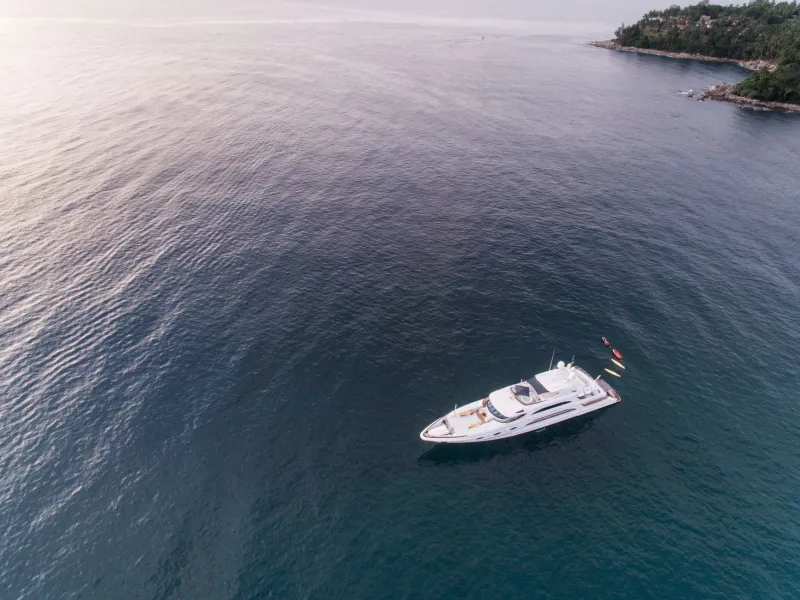
At anchor — often the most coveted portion of a charter itinerary, when guests swim, dine, and watch the sun descend into the horizon — a well-configured hybrid yacht can operate entirely on battery power. No generator hum, no exhaust, no thermal discharge into surrounding waters. The environmental integrity of a remote anchorage is preserved rather than compromised by the vessel's presence within it.
Several European yacht builders have emerged as the engineering vanguard in this space, and American charter operators with the foresight to invest in these platforms early are finding themselves with a competitive advantage that proves difficult to replicate quickly. A genuinely capable zero-emission charter yacht represents a capital commitment that filters the market, ensuring that clients who seek these vessels encounter operators who take the proposition seriously.
Status Redefined at the Highest Level
The sociology of ultra-high-net-worth consumption has always been characterized by what economists call positional goods — items and experiences whose value derives partly from their exclusivity and the signal they send to peers operating within the same social register. For several decades, the largest and most powerful diesel superyacht served that function adequately.
But status markers, like financial markets, are subject to saturation. When a symbol becomes sufficiently accessible — when enough people can acquire the same yacht, the same villa, the same table — its signal value diminishes for those at the apex of the wealth distribution. The response, historically, has been a migration toward the more rarified, the more technically demanding, the more genuinely difficult to obtain.
Zero-emission charter yachts currently occupy precisely that position. They are expensive to build, limited in availability, and require a level of operational expertise that separates serious operators from those simply following a marketing trend. For a client who has chartered extensively and seeks an experience that distinguishes itself from the merely excellent, booking a vessel that performs at the intersection of engineering innovation and environmental integrity communicates something that a larger diesel yacht simply cannot.
It communicates, in the understated language that true luxury has always preferred, that the client understands what the next chapter looks like before most have finished reading the current one.
The Waters That Reward the Choice
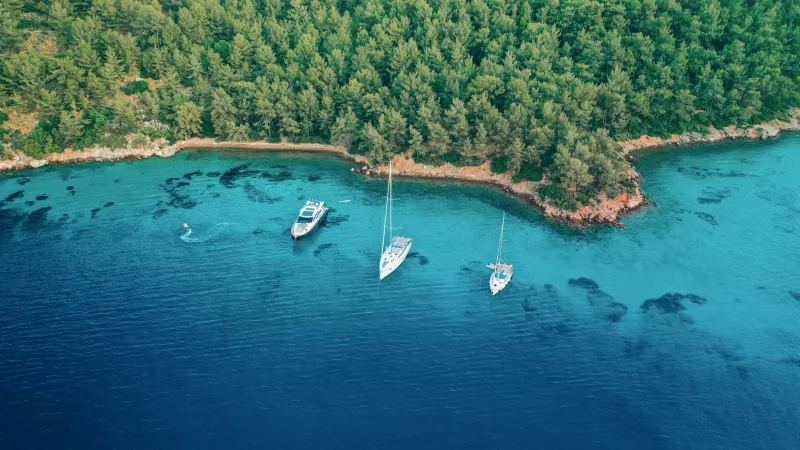
Certain charter destinations amplify the advantages of silent, clean propulsion in ways that make the premium feel not merely justified but essential. The pristine anchorages of the Florida Keys, where marine sanctuary regulations grow increasingly protective of fragile ecosystems. The glacier-fed fjords of Alaska, where the absence of mechanical noise allows wildlife encounters of extraordinary intimacy. The bioluminescent bays of Puerto Rico, where the chemical light of microorganisms responds to the gentlest disturbance and rewards those who arrive without the intrusion of exhaust and vibration.
These are environments that actively reward the zero-emission approach — not as an ideological abstraction, but as a practical enhancement of the experience itself. A charter guest who witnesses a humpback whale surface alongside a vessel running in silent electric mode understands, in that moment, why the technology matters in terms that transcend any environmental argument.
An Investment in the Experience That Awaits
For prospective charter clients considering their next voyage, the zero-emission question is worth raising explicitly with your charter consultant. The fleet of genuinely capable hybrid and electric vessels serving the American market remains select, and matching the right vessel to the right itinerary requires both knowledge and lead time.
What is clear, from every conversation with operators and clients at the forefront of this movement, is that the experience delivered by these vessels is not a compromise in service of principle. It is, by most accounts, a superior experience — quieter, cleaner, more intimate with the natural environment — that also happens to align with the values of a clientele that has never been comfortable accepting that luxury and responsibility must occupy separate categories.
The silence, it turns out, is not an absence. It is the sound of the future of charter travel, arriving precisely on schedule.